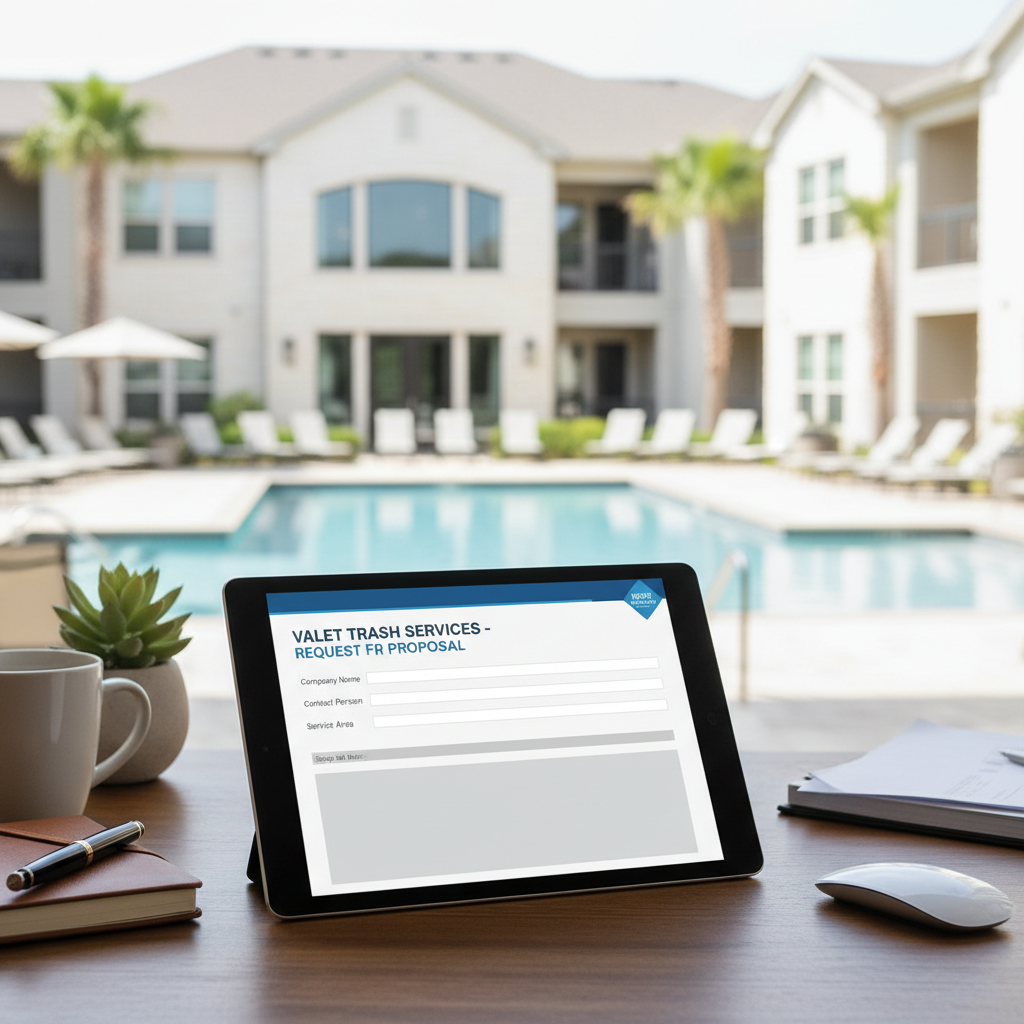
Request a Quote for Valet Trash Services in Texas: A Guide
Get direct, operator-grade insights on how to request a valet trash service quote in Texas. Learn the key inputs, vendor evaluation criteria, and contract terms that impact your NOI.
To effectively request a quote for valet trash services in Texas, operators must provide detailed property specifications, service-level requirements, and desired contract terms. A comprehensive Request for Proposal (RFP) should include unit count, property layout, desired pickup frequency (typically 5 nights/week), and specific scopes like recycling or bulk item disposal to receive an accurate, actionable quote.
TL;DR:
- A detailed RFP is non-negotiable. It must include unit count, site maps, desired pickup schedule, and any special requirements like recycling or bulk item removal.
- Vet vendors based on their operational proof in your specific Texas market (Austin, DFW, Houston, SA), not just their price. Look for route density and local management.
- The vendor's fee should be in the $8–$11 per door range, but your focus should be on the total Net Operating Income (NOI) impact after factoring in resident fees and operational stability.
Deconstructing the Valet Trash RFP
A Request for Proposal (RFP) for valet trash services is the foundational document you send to potential vendors to solicit bids. A well-crafted RFP ensures you receive comparable, transparent quotes that align with your property's specific operational needs and financial goals.
For an effective RFP, you need more than just a unit count. A detailed RFP is the single most important factor in securing a reliable service partner at a competitive price. Vague requests lead to vague proposals with hidden costs and service gaps. Your goal is to eliminate ambiguity and force vendors to compete on a level playing field.
Core Property & Service Details
This is the baseline information every vendor needs to even begin their calculations. Get this wrong, and every quote you receive will be flawed.
Your RFP must include:
- Property Name & Full Address: Include the specific submarket (e.g., "Uptown Dallas," "The Domain in Austin").
- Total Number of Units: The absolute door count.
- Unit Breakdown: Specify the number of 1BR, 2BR, etc. This can sometimes influence container size or waste generation estimates.
- Property Type & Age: Class A, B, or C? Garden-style, mid-rise, or high-rise? The architecture dramatically impacts collection time and thus, cost.
- Site Map: A clear, current property map is non-negotiable. It allows vendors to analyze walk times, staircases, and dumpster locations to create efficient routes.
- Current Waste Situation: Who is your current hauler? What are your current waste costs? Are you aiming to reduce compactor pulls or just add the amenity?
Defining the Scope of Service (SOW)
The Statement of Work (SOW) is where you dictate the service level. This is where you can differentiate a basic service from a premium one. Your SOW should be built around resident experience and operational efficiency.
Key SOW components:
- Pickup Schedule: 5-night/week service (Sunday-Thursday) is the Texas industry standard. Specify exact days.
- Collection Times: Define the window for collection (e.g., "Service begins no earlier than 8:00 PM and concludes by 11:00 PM").
- Resident Setup: When do residents place bins out (e.g., "Between 6:00 PM and 8:00 PM")?
- Container Specifics: Will the vendor provide new, branded trash containers for each unit? Specify this requirement.
- Recycling: Do you require a separate recycling collection? This is a common add-on, especially in markets like Austin with strong recycling mandates. Read more about managing waste streams in our Operator's Guide to Multifamily Waste Management in Texas.
- Common Area Trash: Will the vendor service trash cans at the pool, mailroom, and dog park? Define locations and frequency.
Comparing Bids: Beyond the Per-Door Price
Once quotes arrive, the real analysis begins. The lowest per-door price is not always the best value. An unreliable provider who misses pickups will cost you more in resident complaints and staff time than a slightly higher-priced, operationally sound partner.
Focus on these key areas when comparing valet trash bids:
| Evaluation Criteria | High-Quality Vendor (Operator Focus) | Low-Quality Vendor (Price Focus) |
|---|---|---|
| Pricing Model | $8–$11 per door/month. Transparent, all-inclusive. | Below-market rate ($6-$7) with upcharges for "fuel" or "admin fees." |
| Contract Term | Flexible terms, often 1-3 years with performance-based out clauses. | Locks you into a long-term (5+ year) contract with steep termination penalties. |
| Operational Proof | Provides specific property references in your Texas submarket (e.g., Dallas, Houston). | Vague national portfolio, cannot name a single property within 10 miles. |
| Implementation Plan | Detailed 30-day rollout plan including resident communication, container delivery, and staff training. | "We'll drop off the bins and start next week." |
| Insurance & Liability | Provides a Certificate of Insurance (COI) with adequate liability coverage naming your property as additionally insured. | Hesitates or provides a generic, low-coverage policy. |
The crucial factor is a vendor's operational density in your specific Texas submarket. A provider with multiple properties in North Dallas has the routing efficiency and local management to ensure consistent service. A national provider with only one other client in the entire DFW metroplex is an operational risk. For a deep dive into Dallas specifics, see our Doorstep Trash Pickup Dallas Apartments guide.
The ROI Calculation: Turning a Cost into a Profit Center
Valet trash is not just an expense; it is a significant ancillary revenue stream. The math is simple and powerful. A properly structured valet trash program can generate over $200 in annual net profit per unit.
Here’s a typical ROI framework for a 300-unit property in Texas:
-
Vendor Cost: The provider charges your property a fee per door. With a reputable Texas operator, this cost is typically $8–$11 per door, per month.
- 300 units x $9.50/door = $2,850 per month in vendor costs.
-
Resident Fee: You charge residents a monthly fee for the premium amenity. This is typically $25–$30 per month, a standard and accepted market rate across Texas cities like Houston and Austin.
- 300 units x $28/month = $8,400 per month in ancillary revenue.
-
Net Operating Income (NOI): The difference between the revenue collected and the vendor cost.
- $8,400 (Revenue) - $2,850 (Cost) = $5,550 per month in NOI.
- $5,550 x 12 months = $66,600 in additional annual NOI.
This additional NOI directly increases your property's valuation. Using a 5% cap rate, that $66,600 in annual NOI adds $1,332,000 to your asset's value. Explore the full financial impact in our guide to Doorstep Trash Pickup in Texas Multifamily: The Full ROI.
Contract Terms That Protect Your Asset
The service agreement is your primary tool for ensuring accountability. Do not accept the vendor's standard template without review. Push for terms that favor you, the operator.
Key Contract Clauses to Scrutinize:
- Term & Termination: Avoid long-term contracts (5+ years). Aim for a 1- to 3-year initial term with a "Termination for Convenience" clause that allows you to exit the contract with 30-60 days' notice. At a minimum, demand a performance-based out-clause for documented service failures.
- Price Escalation: The contract should cap annual price increases. Link it to the Consumer Price Index (CPI) or a fixed percentage (e.g., "no more than 3% annually"), not the vendor's discretion.
- Service Level Guarantees (SLAs): The contract must define what constitutes a "missed pickup" and specify penalties, such as service credits to your account for failures. Documented photo evidence from your team should be sufficient proof.
- Indemnification: Ensure the vendor indemnifies and holds your property harmless for any damages or injuries caused by their employees or operations on-site. This is where their insurance coverage becomes critical.
Your valet trash contract is a direct reflection of the vendor's confidence in their own service. A confident, operationally sound partner won't need to lock you into an ironclad 5-year deal. They'll be confident they can earn your business every month.
For more on pricing structures, see our breakdown of Valet Trash Service Cost in Multifamily Texas.
Navigating Texas Submarket Nuances
While the valet trash model is consistent, operational realities differ across Texas metros. A successful Houston implementation requires a different approach than a rollout in Austin.
- Houston: With its sprawling geography, vendor route density is paramount. A provider needs clustered sites to offer reliable service without charging a premium for "drive time." When requesting a quote for a property in Katy, ask the vendor to name their other clients in the vicinity. See our Houston operator's guide for more.
- Dallas-Fort Worth: The DFW market is mature and competitive. Here, vendor differentiation comes down to service quality and technology. Look for providers that use photo verification apps for service accuracy and offer real-time issue tracking for property managers.
- Austin: The city's strong environmental focus means recycling programs are a key part of the service offering. Your RFP for an Austin property must specify whether you need a dual-stream (trash + recycling) collection service to meet resident expectations and city guidelines. Learn more in our Austin operator's guide.
- San Antonio: As San Antonio's multifamily market grows, valet trash is transitioning from a luxury amenity to a standard offering. Focus on vendors who can provide clear resident communication and a smooth rollout to introduce the service to residents who may be unfamiliar with it.
As you analyze your options, remember that all Texas markets fall under the broader insights available on our Texas Multifamily Market hub page.
Frequently Asked Questions
How long does it take to get a valet trash quote?
After submitting a complete RFP with all necessary details (unit count, site map, SOW), you should expect to receive a detailed quote from a professional vendor within 2-3 business days. Be wary of any company that gives you an instant price without seeing a site map; they are not performing proper due diligence.
What is a standard contract length for valet trash service in Texas?
While some vendors will push for 5-year agreements, the operator-friendly standard is a 1-year to 3-year contract. This provides stability for the vendor while giving you the flexibility to re-evaluate partners if service quality declines. Always negotiate for performance-based cancellation clauses.
Can I switch valet trash providers mid-contract?
Switching depends entirely on the termination clause in your current agreement. If you have a "Termination for Convenience" clause, you can switch by giving the required notice (typically 30-90 days). If not, you may need to document consistent, specific service failures (e.g., missed pickups, property damage) that violate the terms of the existing Service Level Agreement (SLA).
Do I need to use the vendor's trash containers?
Yes. Using the vendor-provided, standardized containers is best practice. It ensures a uniform, professional appearance across the property and guarantees the containers are the correct size and durability for the service. This avoids issues with residents using oversized bins or flimsy personal cans that can break and create messes.
What information is most important on a valet trash quote?
Beyond the per-door price, the most critical information is the contract term, the termination clause, and the detailed Statement of Work (SOW). These elements define your risk and the vendor's accountability. A low price on a 5-year, no-escape contract is a liability, not a deal.
How does valet trash service impact my property's waste hauling bill?
A well-managed valet trash service can often reduce the number of compactor/dumpster pulls required from your primary waste hauler, leading to direct cost savings. By ensuring all trash is bagged and brought to the dumpster in a controlled, nightly process, it prevents overflow and optimizes compactor space. This is a key financial benefit beyond the ancillary revenue.
Ready to upgrade your trash valet program?
Discuss your property-specific scope and quote with our team.
Related reading
Property Management Trash Solutions in Texas: The Guide
Effective property management trash solutions in Texas combine valet trash services, smart compactors, and bulk item removal to boost NOI and resident satisfaction. This guide covers the operational specifics for TX markets.
Valet Waste Service for Texas Properties: An Operator's Guide
A guide to valet waste service for Texas properties. Discover how to vet vendors, calculate ROI, and deploy a top-tier trash amenity in Austin, DFW, Houston, and San Antonio.
Texas Apartment Complex Valet Trash: An Operator's Guide
A complete guide to implementing valet trash services in Texas apartment complexes. Learn the ROI, operational best practices, and vendor selection criteria for Austin, DFW, Houston, and San Antonio.