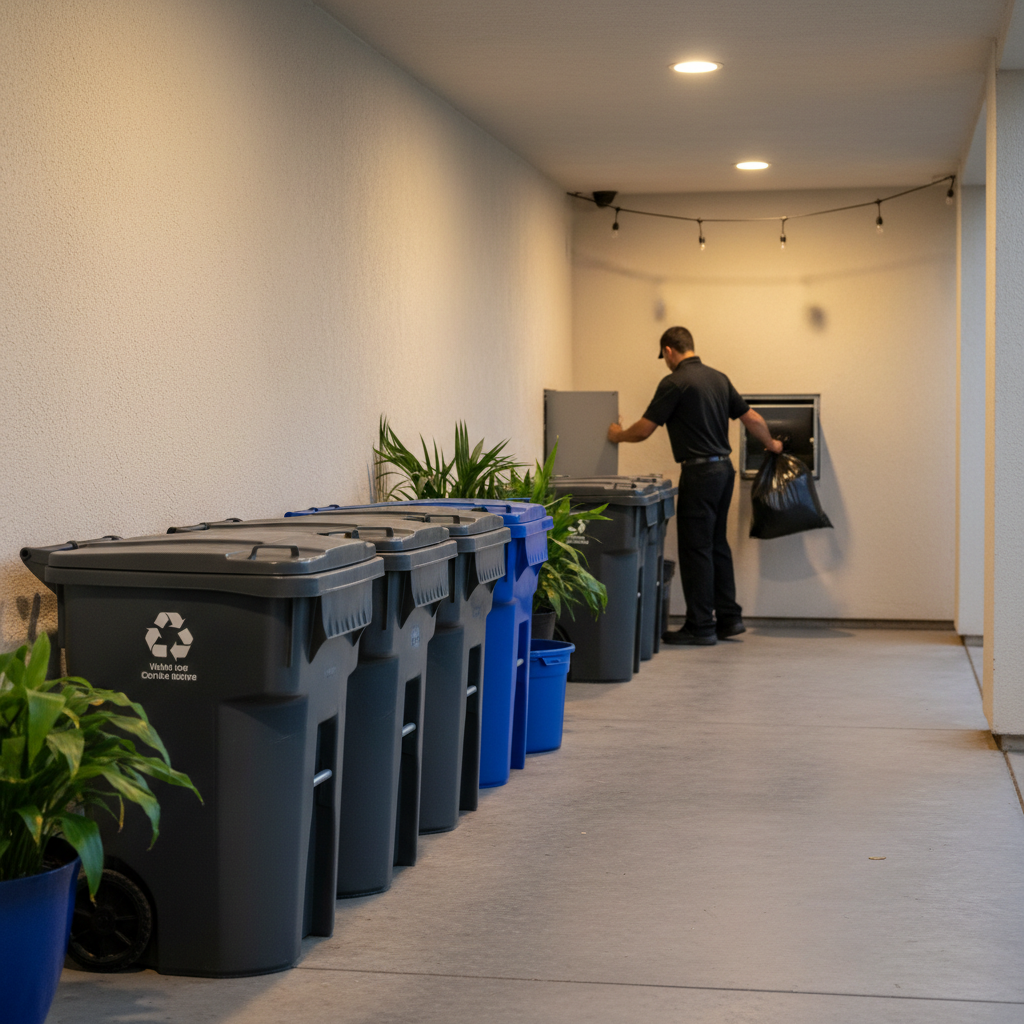
Property Management Trash Solutions in Texas: The Guide
Effective property management trash solutions in Texas combine valet trash services, smart compactors, and bulk item removal to boost NOI and resident satisfaction. This guide covers the operational specifics for TX markets.
''' Effective property management trash solutions in Texas directly increase Net Operating Income (NOI) by creating a new revenue stream and cutting operational waste. Operators typically implement a valet trash service, supplement it with smart compactors for efficiency, and establish a clear protocol for bulk item disposal to streamline operations and enhance resident satisfaction.
TL;DR:
- The best trash solution is a three-part system: daily valet trash service, smart compactors or optimized dumpsters, and a defined bulk trash removal plan.
- Valet trash is a net positive revenue generator. A provider fee of $8–$11 per door per month allows you to charge residents $20–$30, creating $12–$19 in monthly profit per unit.
- Implementation requires phasing the service in with new leases and renewals to avoid violating existing lease agreements, typically taking 6-12 months for full property adoption.
Valet Trash Service: The Core Ancillary Revenue Driver
Valet trash service is the foundation of a modern property management trash solution, shifting waste collection from a maintenance burden to a revenue-generating amenity. This service involves uniformed porters collecting bagged trash directly from residents' doorsteps 5-7 nights a week during set hours, dramatically improving the property's cleanliness and resident experience.
For Texas operators, the financial model is straightforward. The service fee from a provider like Abfall Valet is typically $8–$11 per door, per month, while the mandatory fee charged to residents ranges from $20–$30. This creates a consistent monthly profit of $12–$19 per unit. On a 250-unit property, this translates to $36,000–$57,000 in new annual NOI.
Implementing this service correctly is critical. You cannot add a mandatory fee to an existing lease. The rollout must be phased: new residents sign a lease with the valet trash addendum included, and existing residents are transitioned as their leases come up for renewal. This phased approach, typically taking 6-12 months, ensures a smooth and legally compliant integration. For more detail on the financial returns, see our guide on Doorstep Trash Pickup in Texas Multifamily: The Full ROI.
Choosing a Provider in Major Texas Markets
The valet trash market varies across Texas. In dense, competitive markets like Dallas and Austin, reliability and professionalism are paramount. A missed pickup doesn't just inconvenience a resident; it damages the property's reputation.
- Dallas/Fort Worth: The DFW market is vast. A provider must have the operational density to guarantee service across sprawling suburbs. When vetting a Dallas-area valet trash provider, ask about their supervisor-to-porter ratio and their GPS-verified service reporting.
- Houston: With its high humidity and susceptibility to storms, a Houston provider must have protocols for weather events and a strong focus on container cleanliness to prevent pest issues. See our specific guide for Houston operators.
- Austin: Austin's environmentally-conscious resident base responds well to providers who offer integrated recycling programs. A key differentiator for an Austin valet trash service is the quality of their recycling sorting and resident education.
- San Antonio: As a rapidly growing market, San Antonio properties can use valet trash as a key amenity to compete for new residents. The focus here is on flawless execution to build a premium brand.
Optimizing Collection Points: Dumpsters vs. Compactors
Optimizing your central collection points is the second critical layer of your trash management strategy. This is where the trash collected by valet porters ultimately ends up, and inefficiency here can erode the financial gains from your valet service.
Your two primary options are traditional open-top dumpsters and enclosed trash compactors. While dumpsters have a lower upfront cost, compactors almost always deliver a lower Total Cost of Ownership (TCO) for properties over 150 units by dramatically reducing waste hauling frequency.
The Compactor ROI Framework
A standard 30-yard open-top dumpster might need 3-5 pickups per week, at a cost of $150–$250+ per haul. A 35-yard self-contained compactor holds 4-5 times as much waste, reducing haul frequency to once a week or even bi-weekly.
| Feature | Open-Top Dumpster | Self-Contained Compactor |
|---|---|---|
| Capacity | Low (approx. 8-10 cubic yards loose) | High (holds ~100 cubic yards of loose trash) |
| Haul Frequency | High (3-5x per week) | Low (1x per week or less) |
| Typical Monthly Haul Cost | $1,800 - $5,000+ | $800 - $1,500 |
| Odor & Pest Control | Poor (open top) | Excellent (sealed unit) |
| Upfront Cost | Low (rental included in haul fee) | High ($20,000–$40,000 purchase or lease) |
| Labor Impact | High (frequent cleaning, overflow) | Low (minimal cleaning, no overflow) |
The breakeven point on a compactor purchase is typically 24-36 months. The reduction in monthly hauling fees (often saving $1,000–$3,500/month) pays for the initial investment, after which the savings drop directly to your NOI. Furthermore, compactors eliminate unsightly and unsanitary dumpster overflow, a major resident complaint.
Integrating smart technology with your compactor takes this a step further. Smart compactors have sensors that automatically notify the waste hauler when the unit is 75-80% full, eliminating unnecessary pickups and ensuring a haul is only scheduled (and paid for) when needed. This data-driven approach moves waste management from a fixed expense to a variable, optimized cost.
Managing Bulk Trash & Junk Removal
Bulk trash—discarded furniture, mattresses, and appliances—is an unavoidable operational headache that can quickly degrade a property's curb appeal. A comprehensive property management trash solution must include a clear and efficient protocol for handling it.
Leaving bulk item removal to your on-site maintenance team is a significant drain on resources. A maintenance technician earning $25/hour who spends 4 hours a week dealing with illegal dumping costs the property $5,200 a year in lost productivity. This doesn't include the added costs of dump fees or the risk of injury.
The Three-Pronged Bulk Trash Strategy
- Set Clear Resident Policies: Your lease agreement and resident handbook must explicitly state that residents are responsible for the disposal of their bulk items. Provide a list of local donation centers (Goodwill, Salvation Army) and private junk haulers. A clear policy is your first line of defense.
- Establish a Designated "On-Call" Junk Removal Vendor: Don't scramble to find a hauler every time a couch appears. Vet and onboard a local junk removal company that you can call for same-day or next-day service at a pre-negotiated rate. This ensures fast removal before it becomes a larger eyesore.
- Schedule Quarterly "Community Cleanup" Days: Partner with your valet trash provider or a junk hauler to schedule a specific day each quarter where residents can bring bulk items to a designated area for free removal. This goodwill gesture reduces illegal dumping and provides a valuable resident service. Some external providers may offer separately contracted bulk removal. Abfall Valet provides regular doorstep trash collection only and does not offer bulk service; arrange bulk removal with a separate vendor.
This system transforms bulk trash from a reactive maintenance fire drill into a predictable, managed process. For a deeper dive into overall waste strategies, refer to our Operator’s Guide to Multifamily Waste Management in Texas.
This entire framework is part of a larger strategy for operating effectively in the Texas Multifamily Market, where amenities and operational efficiency are key differentiators.
Frequently Asked Questions
How much does a full valet trash solution cost in Texas?
A complete solution has two main costs. The valet trash service provider fee typically runs $8–$11 per unit per month. Separately, if you invest in a smart compactor, the purchase price is $20,000–$40,000, though leasing options are available. The valet fee is more than offset by the ancillary revenue charged to residents ($20–$30/month).
Can I force my current residents to pay for valet trash?
No. You cannot unilaterally change the terms of an active lease. A mandatory valet trash fee can only be implemented for new residents at lease signing and for existing residents upon lease renewal. This is why a 6-12 month phased rollout is the standard, legally compliant approach.
What is the biggest mistake property managers make with trash?
The most common and costly mistake is viewing trash as a pure expense line item. By not implementing a revenue-generating valet service, operators leave significant NOI on the table. The second-biggest mistake is using on-site maintenance staff for waste-related tasks that are better outsourced, such as bulk item removal and frequent dumpster area cleaning.
How do I measure the ROI of a better trash solution?
Measure ROI with three key metrics. First, calculate direct NOI from valet trash: (Monthly Resident Fee - Monthly Vendor Cost) x Number of Units x 12. Second, track the reduction in waste hauling expenses after switching to a compactor. Third, survey resident satisfaction before and after implementation; improved satisfaction is a leading indicator of better retention.
Is valet trash service worth it for a Class C property?
Yes, absolutely. For Class C assets, valet trash is a powerful tool for repositioning the property and justifying rent increases. It provides a tangible, daily-use amenity that elevates the living experience and brings the property more in line with Class B standards, directly supporting an asset appreciation strategy.
What is the difference between valet trash and junk removal?
Valet trash is a recurring, daily service for collecting standard household trash bags from residents' doorsteps. Junk removal is a one-time, on-demand service for removing large, bulky items like furniture, mattresses, or appliances that do not fit in a standard trash bag or dumpster. '''
Ready to upgrade your trash valet program?
Discuss your property-specific scope and quote with our team.
Related reading
Valet Waste Service for Texas Properties: An Operator's Guide
A guide to valet waste service for Texas properties. Discover how to vet vendors, calculate ROI, and deploy a top-tier trash amenity in Austin, DFW, Houston, and San Antonio.
Texas Apartment Complex Valet Trash: An Operator's Guide
A complete guide to implementing valet trash services in Texas apartment complexes. Learn the ROI, operational best practices, and vendor selection criteria for Austin, DFW, Houston, and San Antonio.
Multifamily Valet Trash Service Texas: An Operator's Guide
A complete operator's guide to implementing multifamily valet trash service in Texas. Learn the ROI, provider selection criteria, and market specifics for Austin, DFW, Houston, and San Antonio.