Multifamily Valet Trash Service Texas: An Operator's Guide
A complete operator's guide to implementing multifamily valet trash service in Texas. Learn the ROI, provider selection criteria, and market specifics for Austin, DFW, Houston, and San Antonio.
A multifamily valet trash service in Texas is a critical amenity for generating ancillary revenue and boosting Net Operating Income (NOI). Operators can typically add $20-$30 per month in resident fees over an $8-$11 per-door vendor cost, creating a reliable new income stream while improving property cleanliness and resident satisfaction across major markets like Dallas and Houston. This service is a key operational lever.
TL;DR:
- Valet trash is a high-margin ancillary service, creating a net positive of $12-$22 per unit per month.
- The right provider acts as an operational partner, directly impacting property cleanliness, resident retention, and staff workload.
- Service standards and pricing vary across Texas markets; what works in a dense Dallas mid-rise may differ from a sprawling San Antonio garden-style community.
Valet Trash Service: Beyond a Resident Amenity
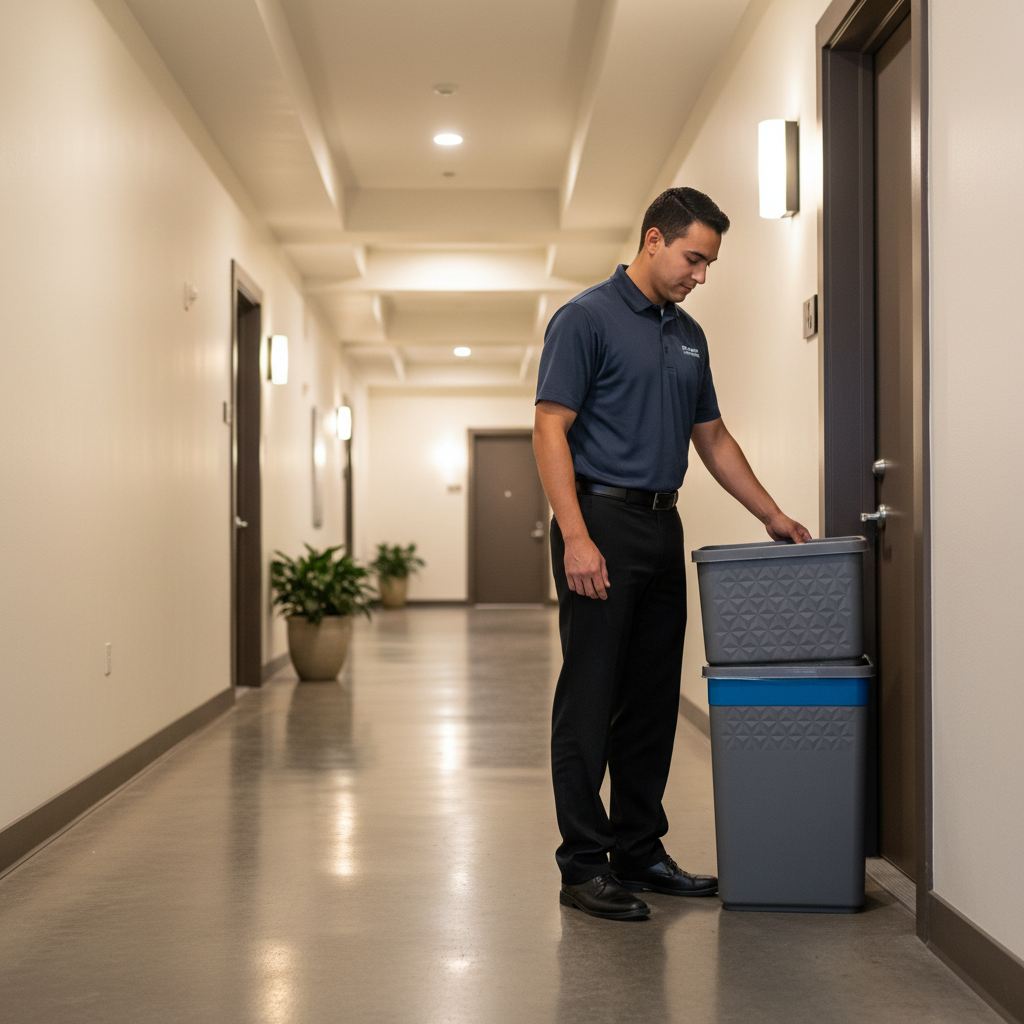
Valet trash service is a system where a third-party provider collects refuse directly from residents' doorsteps and transports it to the property's central dumpsters. For Texas operators, this service transcends a simple convenience; it is a strategic tool for asset value enhancement, NOI growth, and operational efficiency.
Implementing a valet trash program formalizes waste management, a task that otherwise falls to highly-paid maintenance staff or is left to residents, risking property damage and cleanliness issues. The core operational value is converting a chaotic cost center into a predictable, revenue-generating system. By outsourcing this function to a dedicated provider, property managers reclaim valuable staff hours and ensure consistent, professional service delivery that directly impacts curb appeal and resident experience.
Calculating the ROI of Valet Trash in the Texas Market
Valet trash is one of the few amenities that generates more revenue than it costs, directly increasing a property's NOI and, by extension, its asset value. The calculation is straightforward, involving the monthly per-door vendor cost versus the ancillary fee charged to residents.
A typical ROI framework for a Texas property looks like this:
- Vendor Cost: Providers like Abfall Valet charge between $8–$11 per door per month. This is your direct operating expense for the service.
- Resident Ancillary Fee: Properties typically charge residents $20–$30 per month for this premium amenity. This is your gross revenue.
- Net Operating Income (NOI) Lift: The difference between the revenue and the cost. For each unit, this generates a net positive of $12–$22 per month.
Let's apply this to a 250-unit Class B property in the Dallas suburbs:
- Monthly Net Revenue: 250 units * ($25 resident fee - $10 vendor cost) = $3,750
- Annual NOI Increase: $3,750 * 12 months = $45,000
At a 5.5% cap rate, common in many Texas submarkets, this $45,000 in additional NOI translates to a significant increase in asset value:
- Increased Asset Value: $45,000 / 0.055 = $818,181
This calculation proves that implementing valet trash is not an expense, but a direct investment in the property's market value. For more detailed financial modeling, see our guide on the full ROI of doorstep trash pickup in Texas multifamily.
Key Provider Selection Criteria for Texas Operators
Choosing a valet trash provider in Texas requires vetting beyond a simple price quote. The right partner integrates with your operations, enhances your property's brand, and mitigates risk. An unreliable provider, however, creates more work for your on-site teams and damages resident satisfaction.
Use this table to standardize your vetting process across potential vendors:
| Criteria | What to Look For | Red Flags |
|---|---|---|
| Insurance & Compliance | General Liability ($1M+), Workers' Comp, Auto. Adherence to local ordinances (e.g., Dallas noise restrictions). | Missing or under-insured policies. Vague answers on local compliance. |
| Technology & Reporting | GPS-tracked collectors, photo verification of service, digital incident reports, resident-facing app/portal. | Paper-based reporting, no digital verification. Lack of transparency. |
| Staffing Model | W-2 employees (not 1099 contractors), background checked, uniformed, and professionally trained. | Heavy reliance on gig workers (1099s). High turnover. |
| Texas Market Density | Established presence and operational scale in your specific metro (Austin, DFW, Houston, SA). | Limited local teams, long response times, out-of-state management. |
| Contract Flexibility | Clear terms for service nights, ancillary services (bulk removal, recycling), and termination clauses. | Opaque terms, punitive auto-renewals, inflexible service options. |
Your provider is a direct extension of your property management team; their professionalism and reliability are paramount. An operator-grade partner invests in technology for verification and hires W-2 employees, ensuring accountability that you cannot get from a provider using gig workers. This is a crucial distinction explored further in our Dallas operator's guide.
Navigating the Nuances of Major Texas Multifamily Markets
The Texas multifamily landscape is not monolithic. Operational strategies for valet trash must adapt to the unique characteristics of each major metropolitan area. Density, property type, and local regulations all influence service implementation.
Austin
Austin's dense urban core and environmentally-conscious resident base place a high value on recycling and sustainability. Valet trash providers in the Austin market must offer robust, easy-to-use recycling programs alongside standard trash collection. Operators of downtown high-rises and trendy East Austin communities should prioritize vendors who can navigate tight service corridors and offer clear, resident-friendly recycling guidelines.
Dallas-Fort Worth (DFW)
DFW is a market of scale and diversity, from sprawling garden-style apartments in Plano and Frisco to dense mid-rises in Uptown Dallas. The key challenge here is consistent service across a large portfolio. Operators need a provider with significant local density to ensure reliability and backup coverage. In Dallas specifically, compliance with noise ordinances and collection time restrictions is critical, a topic we cover in our guide to apartment trash pickup in Dallas.
Houston
Houston's vast, decentralized layout and susceptibility to weather events like flooding demand operational resilience. A provider must have contingency plans for service disruptions and a large enough local team to cover properties from The Woodlands to Galveston. In sprawling garden-style properties common in Houston, efficient routing and consistent service across the entire site are essential to prevent missed pickups and resident complaints. Our Houston operator's guide offers more detail on these specific challenges.
San Antonio
San Antonio's market often includes a mix of older assets and new developments, particularly along the I-35 corridor. For Class C and B properties, valet trash is a powerful tool for modernization and commanding higher rents. The key is demonstrating value to a price-sensitive resident base. Providers must be exceptionally reliable and professional to justify the ancillary fee. For operators, it's an effective way to upgrade the amenity package without a major capital expenditure.
Implementing a Valet Trash Program: A Phased Framework
A successful rollout minimizes disruption for residents and your on-site team. It requires clear communication and coordination with your chosen provider. A rushed implementation leads to confusion, complaints, and a negative perception of a valuable amenity.
Phase 1: Pre-Launch (30-45 Days Out)
This phase is about logistics and communication. Your provider should be an active partner here.
- Onboarding Meeting: Align with the provider on the service start date, collection times, and specific property rules (e.g., gate codes, designated service areas).
- Resident Communication: Announce the new amenity via email, flyers, and text. Frame it as a property upgrade. Clearly state the start date and the monthly fee. Provide a "Welcome Kit" from the vendor explaining how the service works.
- Lease Addendum: Distribute a lease addendum to all residents outlining the service rules (e.g., designated container, collection times, what not to put out). Make this a standard part of your new lease package going forward.
Phase 2: Service Launch (Day 1)
Execution on Day 1 sets the tone for the entire program.
- Container Distribution: Ensure every resident has received their branded trash container from the vendor.
- Provider On-Site Presence: A good provider will have a manager or lead on-site for the first few nights of service to ensure a smooth start and address any immediate issues.
- Team Huddle: Your on-site team should be fully briefed on the service and prepared to answer resident questions.
Phase 3: Ongoing Management & Optimization (Post-Launch)
This phase focuses on quality control and ensuring the program delivers on its promises.
- Review Service Reports: Your provider should supply digital reports with photo verification and timestamps. Review these to ensure compliance and service quality.
- Resident Feedback: Solicit feedback from residents after the first 30 days. Address any common issues proactively with your vendor.
- Quarterly Business Reviews (QBRs): Meet with your provider quarterly to review service metrics, incident reports, and overall performance. This is a core practice for maintaining a strong partnership, as discussed in our overview of multifamily waste management in Texas.
Frequently Asked Questions
What is the typical cost for valet trash service in Texas?
For the property, the direct vendor cost for a reliable multifamily valet trash service in Texas typically ranges from $8 to $11 per door, per month. Properties then charge residents a monthly fee of $20 to $30, creating a significant net positive income stream. Costs can vary based on property size, location, and service frequency.
How does valet trash increase my property's value?
The service generates ancillary income, which directly increases your Net Operating Income (NOI). Based on a standard cap rate of 5-6% in Texas markets, every dollar of new annual NOI can increase your property's valuation by $16-$20. A 200-unit property generating $30,000 in annual net income from valet trash could see its value increase by over $500,000.
Are W-2 employees really that important for a valet trash provider?
Absolutely. Providers who use W-2 employees instead of 1099 contractors offer a higher degree of reliability, safety, and accountability. W-2 employees are background-checked, trained, and directly managed by the company. This model reduces your liability and ensures a consistent, professional presence on your property, protecting your brand and asset.
What happens if a resident doesn't follow the rules?
Professional providers manage this process through a system of documentation and communication. Typically, the service valet will take a photo of the violation (e.g., trash out at the wrong time, prohibited items), and report it through the provider's app. This report is sent to property management, who can then enforce the lease addendum with clear, documented evidence.
Can valet trash service be implemented in older (Class B/C) properties?
Yes, and it is often a highly effective strategy for modernizing older assets. For Class B and C properties, adding a premium amenity like valet trash allows you to compete with newer developments and justify rent increases without the cost of major capital renovations. It elevates the living experience and signals a commitment to property improvement.
How do I manage valet trash service across a portfolio in different Texas cities?
The key is to partner with a provider that has significant operational density and standardized systems across all major Texas markets. A single provider for your Austin, Dallas, and Houston assets simplifies contract management, reporting, and quality control. This ensures a consistent resident experience and operational standard, no matter the location. Explore more Texas-specific topics on our Texas Multifamily Market hub.
Ready to upgrade your trash valet program?
Discuss your property-specific scope and quote with our team.
Related reading
Property Management Trash Solutions in Texas: The Guide
Effective property management trash solutions in Texas combine valet trash services, smart compactors, and bulk item removal to boost NOI and resident satisfaction. This guide covers the operational specifics for TX markets.
Valet Waste Service for Texas Properties: An Operator's Guide
A guide to valet waste service for Texas properties. Discover how to vet vendors, calculate ROI, and deploy a top-tier trash amenity in Austin, DFW, Houston, and San Antonio.
Texas Apartment Complex Valet Trash: An Operator's Guide
A complete guide to implementing valet trash services in Texas apartment complexes. Learn the ROI, operational best practices, and vendor selection criteria for Austin, DFW, Houston, and San Antonio.