How Valet Trash Service Benefits Property Managers in TX
Valet trash service benefits property managers by creating a new revenue stream, reducing maintenance costs, and boosting resident retention. Learn the NOI impact for your Texas property.
Valet trash service benefits property managers by creating a new, high-margin revenue stream that can add $144-$264 per unit annually, while also reducing maintenance workload and improving property cleanliness. This service directly boosts Net Operating Income (NOI) and enhances resident satisfaction with minimal operational lift.
TL;DR:
- Valet trash is a profit center, generating $12-$22/unit/month in pure NOI by marking up the service fee from the vendor cost of $8–$11 per door.
- The service significantly reduces the operational burden on maintenance teams, freeing them from trash-related tasks to focus on value-add work orders.
- It systematically improves property cleanliness and curb appeal, which supports higher market rents, better resident retention, and increased asset value.
Driving NOI: The Financial Framework of Valet Trash
Valet trash is a direct and powerful tool for increasing Net Operating Income (NOI). It’s not an expense line item; it is a revenue-generating ancillary service that flows high-margin cash straight to the bottom line, directly increasing an asset’s valuation upon sale.
For property managers and asset managers in Texas, the math is straightforward. The goal is to implement a mandatory resident amenity fee that covers the vendor’s service cost and generates a significant profit margin. The average operator in Austin, Dallas, Houston, or San Antonio can generate $12-$22 per unit, per month in profit.
Here’s the typical financial structure:
- Vendor Service Cost: A reliable valet trash provider in Texas charges between $8–$11 per door, per month.
- Resident Ancillary Fee: The property charges residents a mandatory fee of $20–$30 per door, per month.
- Net Revenue: The difference between the resident fee and the vendor cost is pure profit.
NOI Impact Analysis: 250-Unit Property Example
Let's model this for a standard 250-unit, Class B apartment complex in the Dallas-Fort Worth metroplex. The analysis shows a clear financial win.
| Metric | Without Valet Trash | With Valet Trash (Conservative) | With Valet Trash (Aggressive) |
|---|---|---|---|
| Vendor Cost / Unit / Month | $0 | $10 | $10 |
| Resident Fee / Unit / Month | $0 | $25 | $30 |
| Profit / Unit / Month | $0 | $15 | $20 |
| Monthly Net Revenue (250 units) | $0 | $3,750 | $5,000 |
| Annual Net Revenue | $0 | $45,000 | $60,000 |
At a 5.5% cap rate, that $45,000 to $60,000 in additional annual NOI translates to an increase in asset value of approximately $818,000 to $1,090,000. This is a material impact driven by a single, easy-to-implement service.
Reducing Operational Drag on Maintenance Teams
Your maintenance staff are among your most valuable assets, and their time is expensive. Reducing operational drag means freeing them from low-value tasks to focus on turning units, completing service requests, and performing preventative maintenance. Valet trash services directly attack one of the biggest time-sinks: managing resident waste.
Without a valet service, your maintenance team is your de facto trash crew. They spend billable hours on "trash patrol." This includes:
- Picking up loose trash around the property and in breezeways.
- Breaking down oversized boxes and furniture left at the dumpster.
- Cleaning up spills and leaks from residents dragging trash bags to the compactor.
- Dealing with compactor jams and overflows, a frequent issue in large Texas apartment communities.
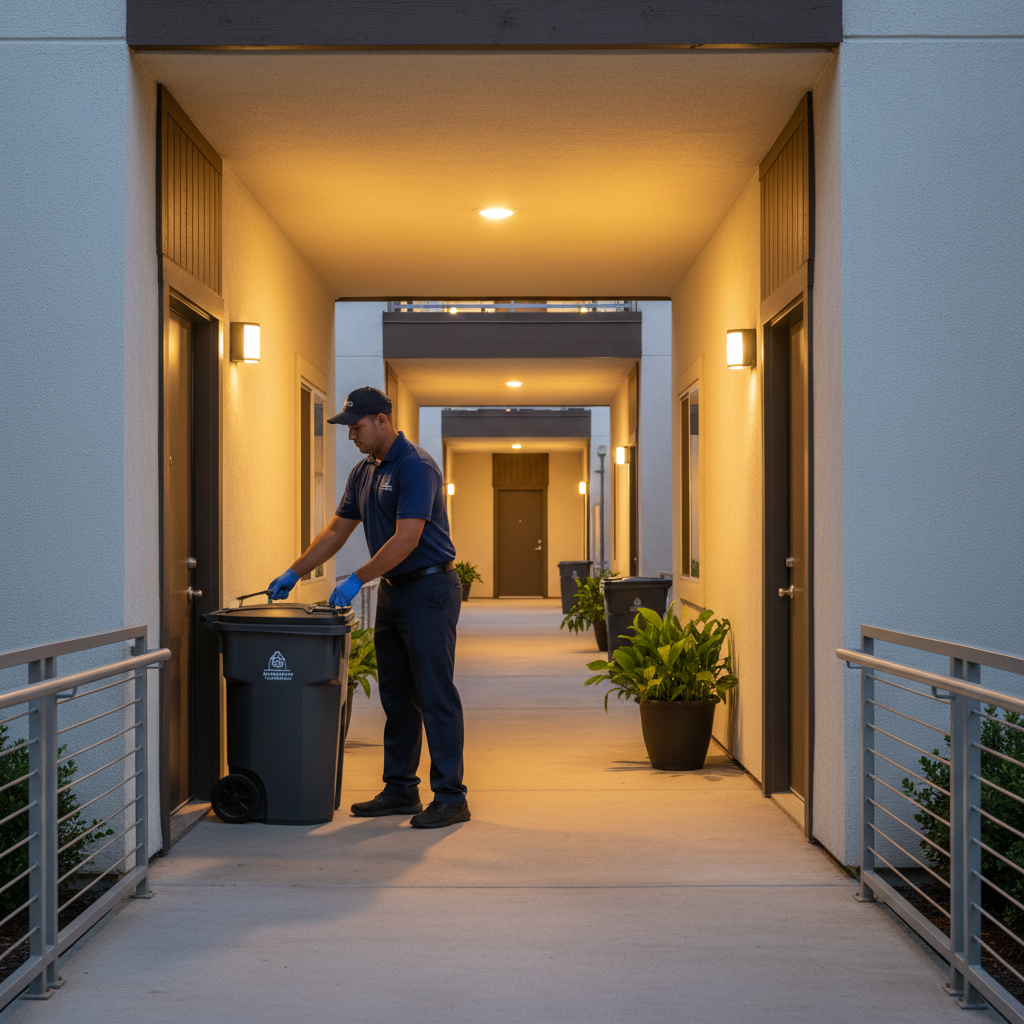
By outsourcing doorstep collection, you transfer these responsibilities to the valet trash vendor. Their service includes collecting bagged trash from every resident, every service night. This simple shift ensures your maintenance supervisor is directing his team toward work that protects the asset and satisfies residents, not cleaning up another tenant's spilled coffee grounds. This operational efficiency is a core component of Property Management Best Practices.
Enhancing Curb Appeal and Asset Value
A property’s cleanliness is a direct reflection of its management quality and directly impacts its market position. Valet trash services provide a systematic solution for maintaining a clean, attractive property, which is crucial for attracting and retaining high-quality residents in competitive markets like Austin and Houston.
A clean property commands higher rent and supports stronger occupancy. Valet trash eliminates the primary sources of property messiness:
- Breezeway Stains & Litter: It prevents residents from dragging leaky trash bags down stairwells and through common areas, reducing stains and pest issues.
- Unsightly Dumpster Areas: Central dumpsters become less of an eyesore. With less daily volume from individual residents, overflows are rare. This also helps when conducting an audit of your waste removal services.
- "Trash Staging": It eliminates the problem of residents leaving trash bags outside their doors for hours on end, waiting for a convenient time to go to the dumpster.
During a leasing tour, the path from the clubhouse to the model unit is a critical part of the prospect's first impression. A clean, odor-free breezeway communicates a level of quality and care that justifies premium rental rates. A property stained by trash leakage sends the opposite message.
The Modern Resident Retention Amenity
In the Texas multifamily market, valet trash is no longer a luxury perk; it is a standard amenity for Class A and B properties. Residents now expect the convenience of doorstep collection, much like they expect an in-unit washer/dryer or a functional fitness center. Failing to offer it puts a property at a competitive disadvantage.
This service is a powerful tool for resident satisfaction and retention. The benefit is simple and tangible: residents no longer have to make late-night trips to a distant, often poorly lit dumpster. This is a significant quality-of-life improvement, especially for residents on upper floors, single women, or anyone concerned with safety and convenience.
Happy residents are more likely to renew their leases, which is the single most effective way to reduce turnover costs (marketing, make-ready, vacancy loss). While amenities like a pool or dog park are used by a fraction of residents, valet trash is an amenity used by 100% of your residents, multiple times per week. For a deeper dive into service specifics, view The Operator's Guide to Valet Trash Service for Apartments in Texas.
Frequently Asked Questions
How much does valet trash cost a property?
The direct cost to the property management company for a reliable, insured valet trash vendor in Texas is typically $8–$11 per occupied unit per month. This cost is then marked up significantly when charged to the resident as a mandatory fee, creating the profit stream.
Will residents push back on a mandatory valet trash fee?
For new leases, the valet trash fee is simply part of the amenity package. For existing residents during a phased rollout, pushback is minimal when the value is communicated properly. In Texas, the service is so common that most renters moving from other professionally managed properties already expect it. It's viewed as a standard utility, not an optional luxury.
How does valet trash impact my contract with a waste hauler?
Valet trash is a complementary service that works in tandem with your primary waste hauler (like Waste Management, Republic Services, etc.). Your valet provider collects trash from resident doors and delivers it to the on-site dumpsters or compactors. Your hauler then empties those dumpsters as usual. In some cases, the efficiency of valet trash may allow you to adjust and potentially reduce the frequency of hauler pickups, offering another avenue for savings. This is a key part of managing your overall apartment complex trash pickup strategy.
What is the implementation process like?
An experienced vendor makes the process seamless. It typically involves a 30-day rollout plan:
- Notice: Management provides official notice to residents about the new premium amenity.
- Bin Delivery: The vendor delivers a branded trash container to each resident's door.
- Service Start: On the designated start date, porters begin nightly collection according to the agreed-upon schedule (usually 5 nights a week).
How are rule violations (e.g., leaving trash out at the wrong time) handled?
Professional valet trash companies use technology to manage compliance. Porters use a mobile app to take time-stamped photos of violations. This evidence is sent to management in a daily report. This allows your team to enforce lease addendum rules consistently and with clear documentation, minimizing resident disputes and ensuring the program runs smoothly.
Is valet trash a good fit for older, Class C properties?
Absolutely. For asset managers looking to reposition a Class C property, adding valet trash is a fast and cost-effective way to introduce a Class A amenity. It can be a key part of a value-add strategy, justifying rent bumps and improving the overall resident profile and property cleanliness ahead of a larger renovation or sale.
Ready to upgrade your trash valet program?
Discuss your property-specific scope and quote with our team.
Related reading
A PM's Guide to Improving Multifamily Resident Experience
Elevate your Texas apartment community by focusing on three core pillars: operational excellence, high-touch communication, and premium amenities. Learn how to boost resident satisfaction and retention.
11 Cost-Saving Strategies for Apartment Complexes in Texas
Discover 11 operator-grade cost-saving strategies for apartment complexes in Texas. Cut utility expenses, optimize vendor contracts, and boost your Net Operating Income (NOI) with actionable frameworks for PMs.
5 Cost-Saving Strategies for Multifamily Communities in TX
Practical cost-saving strategies for Texas multifamily communities that boost NOI. Learn to cut utility, maintenance, and vendor expenses without sacrificing quality.