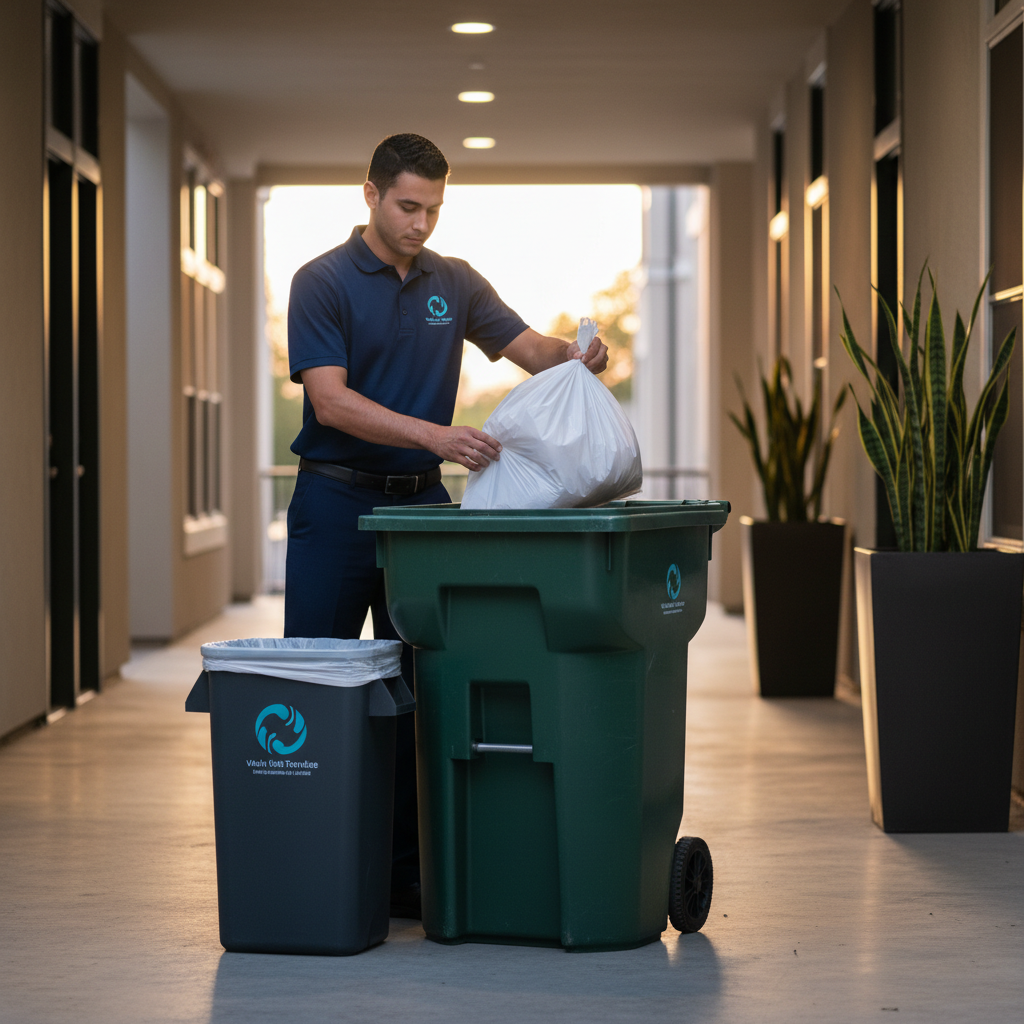
The Operator's Guide to Valet Trash Service for Apartments in Texas
A definitive guide for Texas property managers on implementing valet trash service. Learn to calculate NOI impact, vet vendors, and execute a flawless rollout to boost asset value and resident retention.
The State of Play: Why Valet Trash is Standard-Issue in Texas Multifamily
In the hyper-competitive Texas apartment markets of Dallas-Fort Worth, Houston, Austin, and San Antonio, the amenity race is constant. Ten years ago, valet trash service was a luxury. Today, it is a competitive necessity and a critical operational asset. For property managers, regional managers, and asset managers, viewing valet trash as merely a resident perk is a fundamental miscalculation. It is a significant driver of Net Operating Income (NOI), a tool for resident retention, and a key factor in maintaining property cleanliness and curb appeal.
Texas properties are characterized by sprawling garden-style communities and increasingly dense mid-rise and high-rise urban developments. This density creates significant waste management challenges:
- Dumpster Logistics: Centralized dumpsters become overwhelmed, especially in large communities. They are unsightly, create odor problems, and require residents to transport their trash long distances, sometimes in inclement weather.
- Staff Burden: Your maintenance team spends valuable hours cleaning up overflowing dumpster corrals, picking up loose trash, and dealing with illegal dumping of furniture and bulk items. This is low-value, morale-killing work that distracts from revenue-generating make-readies and work orders.
- Resident Dissatisfaction: Leaky trash bags dragged down stairwells, pests attracted to overflowing bins, and the general inconvenience of "taking out the trash" are consistent sources of negative resident feedback and poor online reviews.
Valet trash service directly addresses these operational pain points. It standardizes waste collection, enhances property aesthetics, and shifts resident perception from a chore to a seamless service. In Texas, where the fight for resident acquisition and retention is fierce, failing to offer this amenity puts your asset at a distinct disadvantage.
The Operator's Framework: From "Trash Service" to Ancillary Revenue Engine
Top-tier operators do not view valet trash as a cost center. They structure it as a mandatory ancillary revenue stream that directly increases the property's value. The math is simple, powerful, and essential for any conversation with asset management or ownership.
Here is the direct framework for calculating the financial impact. Do not let a potential vendor sell you on the service without running these numbers first.
The NOI Impact & Asset Valuation Formula
Let's model a typical 300-unit, Class B garden-style community in a Dallas suburb.
Inputs:
- Number of Doors: 300
- Mandatory Monthly Resident Fee: $30
- Negotiated Vendor Cost Per Door: $9.50
- Market Cap Rate: 5.0%
Step 1: Calculate Monthly Net Profit
- Gross Revenue Per Door: $30
- Direct Cost Per Door: $9.50
- Net Profit Per Door: $20.50
- Total Monthly Net Profit: 300 Doors x $20.50 = $6,150
Step 2: Calculate Annual NOI Contribution
- Total Monthly Net Profit: $6,150
- Annual NOI Increase: $6,150 x 12 Months = $73,800
Step 3: Calculate Increase in Asset Value
- Formula:
Increase in Asset Value = Annual NOI Increase / Cap Rate - Calculation:
$73,800 / 0.05 - Total Increase in Asset Value: $1,476,000
By implementing a mandatory valet trash program, you have added over $1 million to the property's valuation. This is the language that owners and asset managers understand. The service fee is not just covering a vendor cost; it is generating pure profit that flows directly to the bottom line.
This framework is the foundation. Every decision you make—from vendor selection to contract negotiation—should be aimed at protecting and maximizing this NOI.
Valet Trash Service Models: A Breakdown for Texas Operators
Not all valet trash service is created equal. Understanding the different models allows you to match the service level to your property class, resident demographic, and budget.
Standard 5-Night Service (Sunday-Thursday)
This is the industry standard and the most common model across Texas multifamily. It aligns with typical waste generation patterns, with service resuming Sunday evening after the weekend and pausing on Friday and Saturday when collections are typically lighter. It provides the ideal balance of convenience and cost-effectiveness for most Class A and Class B properties.
Premium 7-Night Service
Offered in high-end, Class A+ communities, particularly in dense urban cores like Downtown Austin or Uptown Houston. The resident demographic in these properties has a lower tolerance for any buildup of waste. While the vendor cost is higher, the mandatory resident fee can also be increased to maintain a healthy profit margin. This service level is a statement of premium living and can be a compelling differentiator at the top of the market.
Integrated Recycling Programs
Recycling is no longer optional. Most Texas municipalities have diversion goals, and residents, particularly millennials and Gen Z, expect a viable recycling option. A professional valet trash vendor must offer a clear, manageable recycling program.
- Execution: This typically involves providing residents with separate, distinctively colored (often blue) bags. The valet collects these bags on designated nights or simultaneously with the trash.
- The Contamination Problem: The biggest challenge is contamination. One resident putting non-recyclables in a blue bag can contaminate an entire batch, leading to fines from the waste hauler. Your vendor must have a proactive plan for resident education and a protocol for tagging and leaving contaminated bags with an educational note. Ask potential vendors how they manage and report contamination rates.
Bulk Trash & Junk Removal
This is a major pain point where professional vendors separate themselves from basic operators. A standard valet trash contract does not include the removal of furniture, mattresses, or large electronics. These items are often left by the dumpsters during move-outs, creating an immediate eyesore and burdening your maintenance staff.
A true service partner will offer a separate, on-demand bulk removal service. Best-in-class providers integrate this into their property management portal, allowing you to schedule a pickup for a specific unit or area with a few clicks. This transforms a reactive problem into a managed process, keeping your property clean, especially during the heavy turn season.
Vetting Your Vendor: The Difference Between a Partner and a Problem
Choosing the cheapest provider is a classic short-term decision with long-term negative consequences. Inconsistent service, missed pickups, and unprofessional staff will erode resident trust and create more work for your on-site team, wiping out any cost savings. Use this checklist to vet potential vendors.
Key Vetting Questions:
-
Operational Reliability & Tech:
- "What is your guaranteed service completion rate?" (Should be 99.5% or higher).
- "How do you verify service? Do your valets use GPS tracking and provide photo verification for every stop?"
- "Do you have a dedicated client portal for reporting issues, viewing service reports, and requesting bulk pickups?"
-
Insurance & Liability:
- "What are your general liability and workers' compensation coverage limits?" (Demand to see their Certificate of Insurance).
- "Will you name our property and management company as additionally insured?" (This is non-negotiable).
-
Labor Model:
- "Are your service valets W-2 employees or 1099 independent contractors?" (W-2 employees are generally more reliable, better trained, and more professional. High turnover with 1099 contractors often leads to inconsistent service).
-
Texas Market Presence:
- "How many units do you currently service in the [Austin/DFW/Houston/SA] metro area?"
- "Where is your local supervisor based? What is the escalation path for after-hours service issues?" (A national call center is not a substitute for local leadership).
-
Contract Terms:
- "What are the terms for termination for cause? What is your SLA for curing service failures?"
- "Does your contract include an automatic renewal clause? What is the notification window required to prevent renewal?" (Beware of lengthy, restrictive auto-renewal terms).
A vendor who can provide clear, confident answers to these questions is more likely to be a reliable partner. A vendor who is evasive is a red flag.
The Implementation Playbook: A Step-by-Step Guide
A smooth rollout is 90% communication. A well-executed launch prevents resident confusion, builds buy-in, and sets the tone for a successful program.
Phase 1: Contract & Negotiation (Day -45)
- Finalize Vendor Selection: Use the vetting checklist above.
- Negotiate Key Terms: Focus on securing a 30 or 60-day "out" for non-performance. Clearly define what constitutes a service failure (e.g., more than X missed units in a week, failure to clean up spills).
- Set the Go-Live Date: Choose a date that avoids major holidays or peak move-in/move-out weekends.
Phase 2: Resident Communication & Rollout (Day -30 to Day 0)
- Day -30: The Announcement: Send the first official email and/or letter to all residents. Announce the new amenity, the start date, and the mandatory fee. Frame it around the benefits: cleanliness, convenience, and safety.
- Day -15: The Logistics: Distribute the branded trash containers to each unit. Attach a detailed instruction sheet. This sheet must include:
- Service days and pickup times (e.g., "Place container outside between 6 PM and 8 PM, Sunday-Thursday").
- Proper bag etiquette (all trash must be bagged and tied).
- Container placement (exactly where to place the can to ensure efficient pickup).
- Recycling rules (if applicable).
- Contact info for questions.
- Day -7: The Reminder: Send a one-week reminder email.
- Day -1: Eve of Launch: Send a final reminder: "Your new valet trash service begins tonight!"
- Day 0: Go-Live: The vendor begins service. Your on-site team and the vendor's local supervisor should be on high alert, ready to address any immediate issues.
Phase 3: Ongoing Management & Quality Assurance (Day 1+)
- Weekly Check-ins: For the first month, have a standing weekly call with your vendor account manager to review service reports and address any resident-reported issues.
- Establish a Feedback Loop: Make it easy for residents to report a missed pickup or service issue. The best vendors provide an app for this. If not, ensure your office team has a clear process for logging and transmitting issues to the vendor.
- Walk the Property: Your team should periodically walk the breezeways in the morning after pickup to spot-check for missed cans or messy areas. Trust, but verify.
How This Fits Together: Building Your Property Management Playbook
This guide provides the foundational framework for implementing a successful valet trash program in Texas. But effective property management is about mastering the details. This article is the central hub for our "Property Management Best Practices" series. Each of the following topics will be explored in a dedicated, in-depth post that links back to this core strategy.
-
Spoke 1 Preview: The Ancillary Revenue Deep Dive. We’ve shown the basic NOI formula. Our next piece will break down advanced strategies, including tiered service pricing, calculating revenue from bulk removal, and bundling valet services with other amenities to maximize profit per door.
-
Spoke 2 Preview: The Vendor Scorecard. Choosing the right partner is mission-critical. We will release our proprietary "Vendor Scorecard," a downloadable checklist with weighted criteria to objectively compare valet trash providers in the Texas market, moving beyond price to true value.
-
Spoke 3 Preview: The Resident Communication Toolkit. A smooth rollout depends on world-class communication. We will provide a full toolkit with email templates, door hanger designs, and FAQ sheets to ensure your residents understand and value the new service from day one, minimizing complaints and confusion.
-
Spoke 4 Preview: Mitigating Common Service Failures. What do you do when pickups are missed or breezeways are left messy? Our next guide will provide an operator's framework for troubleshooting common valet trash issues, enforcing Service Level Agreements (SLAs), and leveraging contract terms to hold your vendor accountable.
-
Spoke 5 Preview: Valet Trash and Due Diligence. A guide for asset managers and acquisitions teams. We will detail how to evaluate an existing valet trash program during due diligence and identify opportunities for operational lift, contract renegotiation, and NOI improvement immediately following an acquisition.
Frequently Asked Questions (FAQ)
What is the typical cost of valet trash service for apartments in Texas?
For the property, the direct cost from a reliable vendor typically ranges from $8–$11 per door, per month. The mandatory fee charged to residents is then set between $25 and $35 per month. This spread creates the net profit that drives NOI.
Can we make valet trash mandatory for all residents?
Yes. This is the standard and correct way to implement the service. It is enforced through a lease addendum. New residents sign the addendum with their lease, and existing residents sign it upon renewal. This ensures 100% participation, which is necessary for the program's financial and operational success.
How do professional valet trash services handle recycling?
Reliable vendors manage recycling through a "dual-stream" process. They provide residents with specific bags for recyclables and educate them on what is acceptable to prevent contamination. Valets collect these bags on designated nights. A key differentiator of a good service is their reporting on contamination rates and their proactive educational efforts (e.g., tagging incorrect bags).
What is the biggest mistake properties make when implementing valet trash?
There are two common, critical mistakes. The first is choosing the cheapest vendor without proper vetting, leading to unreliable service that creates more problems than it solves. The second is poor communication with residents during the rollout, which causes confusion, frustration, and pushback against a service that should be perceived as a high-value amenity.
How does valet trash improve property cleanliness and reduce on-site staff burden?
It centralizes and containerizes waste, eliminating the common sight of overflowing dumpsters and loose trash blowing around the property. It stops residents from dragging leaky bags through common areas and breezeways. This directly frees up your maintenance team from cleaning dumpster corrals and chasing litter, allowing them to focus on work orders and turning units—activities that directly impact revenue and resident satisfaction.
The Bottom Line: A Non-Negotiable Asset
In the Texas multifamily market, valet trash service is no longer a fringe benefit; it is a core component of a professionally managed property. When implemented correctly, it is a powerful lever for increasing NOI and asset value, a clear differentiator in the competition for residents, and a practical tool for improving operational efficiency and property cleanliness.
The question is not if you should implement valet trash, but how you can execute it with operational excellence. By using a disciplined framework for financial calculation, vendor vetting, and resident communication, you can transform a simple trash service into a significant strategic asset.
Ready to upgrade your trash valet program?
Discuss your property-specific scope and quote with our team.
Related reading
A PM's Guide to Improving Multifamily Resident Experience
Elevate your Texas apartment community by focusing on three core pillars: operational excellence, high-touch communication, and premium amenities. Learn how to boost resident satisfaction and retention.
11 Cost-Saving Strategies for Apartment Complexes in Texas
Discover 11 operator-grade cost-saving strategies for apartment complexes in Texas. Cut utility expenses, optimize vendor contracts, and boost your Net Operating Income (NOI) with actionable frameworks for PMs.
5 Cost-Saving Strategies for Multifamily Communities in TX
Practical cost-saving strategies for Texas multifamily communities that boost NOI. Learn to cut utility, maintenance, and vendor expenses without sacrificing quality.