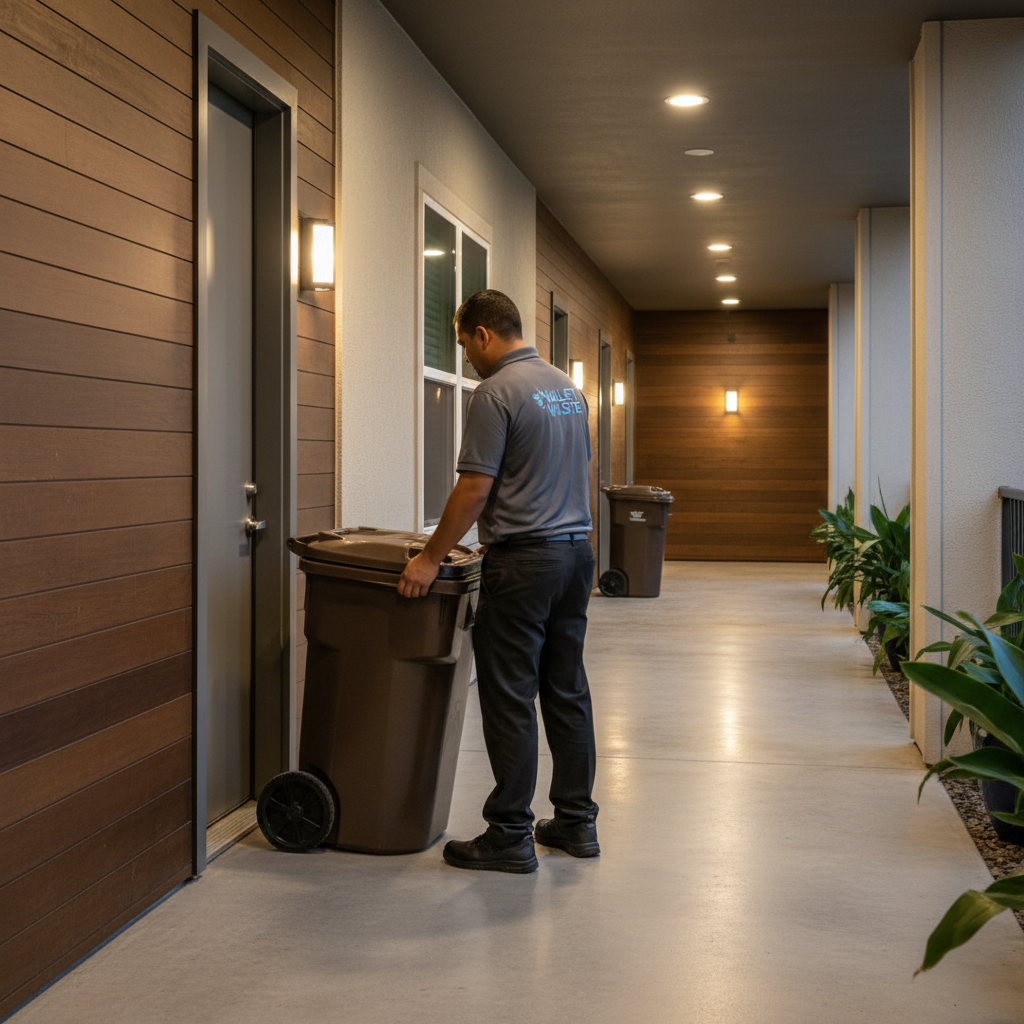
Calculating the ROI of Valet Trash for Apartments
Stop viewing valet trash as an expense. Learn how Texas multifamily operators generate significant ancillary revenue, boost NOI, and increase asset value with this essential amenity.
The ROI of valet trash for apartments is a significant net-positive, transforming a municipal utility into a powerful ancillary revenue stream. By charging residents a $25-$30 monthly fee against an $8-$11 vendor cost, Texas properties can add tens or hundreds of thousands to their annual Net Operating Income (NOI).
TL;DR:
- Valet trash is a profit generator, creating a new ancillary income stream that flows directly to your NOI.
- The service increases asset value by adding significant annual profit, which is amplified by your property's cap rate.
- Operational ROI comes from reduced maintenance workloads, cleaner common areas, and improved curb appeal, justifying the program beyond direct revenue.
From Cost to Profit: The Valet Trash ROI Formula
The fundamental ROI of valet trash stems from a simple formula: the ancillary revenue collected from residents minus the per-door service cost paid to the vendor. This calculation reveals the direct profit generated by the program.
For Texas operators, the math is straightforward and compelling. A typical resident-facing fee for valet trash is $25–$30 per month. The cost from an operator-focused vendor like Abfall Valet is typically $8–$11 per door, per month. The delta between those two numbers is pure profit.
The basic formula is:
(Monthly Resident Fee - Monthly Vendor Cost Per Door) x Occupied Units x 12 = Annual Gross Profit
The core of valet trash ROI is its function as a revenue-generating amenity, not a cost center. This simple shift in perspective is critical for asset managers evaluating portfolio-wide ancillary income opportunities. This isn't about spending money; it's about investing in a program that pays for itself multiple times over.
How Valet Trash Directly Boosts Net Operating Income (NOI)
Valet trash service boosts Net Operating Income (NOI) by creating a consistent, high-margin ancillary revenue stream. This new income flows directly to the bottom line, increasing the property's overall profitability.
Unlike other amenities that require significant capital expenditure and have unclear returns, valet trash is an operational program with immediate, measurable financial upside. The revenue collected is predictable and scales with occupancy. For a 300-unit property, this can mean over $60,000 in new annual profit.
This is not theoretical. It's a proven model working across thousands of doors in Austin, Dallas, Houston, and San Antonio. The single most important financial benefit of valet trash is its direct, positive impact on NOI.
Sample NOI Impact Analysis (300-Unit Property)
This table breaks down the real-world financial impact for a typical Class A or B asset in the Texas market.
| Metric | Calculation / Value | Monthly Impact | Annual Impact |
|---|---|---|---|
| Number of Units | 300 | - | - |
| Occupancy | 95% | 285 Units | 285 Units |
| Resident Ancillary Fee | $28 / Unit | $7,980 | $95,760 |
| Vendor Service Cost | $9.50 / Unit | $2,707.50 | $32,490 |
| Gross Profit (New NOI) | (Fee - Cost) x Units | $5,272.50 | $63,270 |
This additional $63,270 is not just revenue; it's high-margin profit that enhances the financial performance of the asset. For a deeper look at the various ways valet service contributes to financial health, see our guide on the valet trash benefits that boost multifamily NOI.
The Impact on Asset Value: A Cap Rate Conversation
The increase in NOI from valet trash directly translates to a higher property valuation when applying the market's capitalization (cap) rate. This makes the service a powerful tool for asset managers focused on long-term value creation.
Asset managers in competitive Texas markets understand that every dollar of sustainable NOI is critical. The profit generated from a valet trash program is exactly that: a stable, predictable income stream that appraisers and potential buyers recognize.
Using the $63,270 in new annual NOI from our example above, the impact on asset value is profound. Assuming a 5.0% cap rate, a common figure for stabilized assets in major Texas metros:
$63,270 (Annual Profit) / 0.05 (Cap Rate) = $1,265,400 (Increase in Asset Value)
Every dollar of new, sustainable NOI from valet trash is magnified into $18-$22 of asset value. This calculation is fundamental to the hold/sell analysis for any multifamily property. The ancillary income from valet trash is not just operational cash flow; it is a direct multiplier of the property's worth.
Operational Efficiencies: The "Soft" ROI for On-Site Teams
Beyond direct profit, valet trash delivers significant operational ROI by freeing up maintenance staff from trash-related duties. This allows teams to focus on revenue-generating work orders and preventative maintenance, improving overall efficiency.
Your maintenance team is one of your most valuable assets, but their time is often consumed by non-essential tasks. In the Texas heat, managing dumpster areas is a physically demanding, time-consuming job. Delegating this responsibility creates immediate "soft" ROI:
- Reduced Payroll Burn: Maintenance staff no longer spend 1-2 hours per day shuttling trash from compactors to dumpsters, dealing with overflows, or cleaning up spills. This time can be reallocated to turning units faster or addressing resident service requests.
- Improved Curb Appeal: A professional valet service eliminates overflowing dumpsters and trash bags left in breezeways. This cleanliness makes a powerful first impression on prospective residents during tours.
- Lower Risk: Centralized trash areas can be magnets for pests and even fire hazards. A door-to-door service mitigates these risks, reducing the likelihood of costly remediation.
Delegating trash management to a dedicated vendor frees up hundreds of maintenance hours annually. This reclaimed time translates directly into a more efficient, responsive, and ultimately more profitable operation. It's a core component of optimizing Valet Trash Operations & ROI.
Finding the Right Partner to Maximize ROI
The promised ROI of valet trash is only achievable with a reliable, operator-focused vendor. Choosing the right partner ensures consistent service, happy residents, and the realization of financial benefits without creating new operational headaches.
A cheap but unreliable provider will cost you more in the long run. Missed pickups, unprofessional staff, and poor communication erode resident satisfaction and create constant fires for your property managers to put out. This negates the entire purpose of the program.
Your projected ROI is meaningless if the service isn’t executed reliably. An operator-grade partner acts as an extension of your team, providing consistent, professional service that justifies the ancillary fee. When vetting potential providers, it's crucial to understand the nuances of choosing a valet trash vendor in Texas to ensure your financial projections become a reality.
Frequently Asked Questions about Valet Trash ROI
This section addresses common questions property and asset managers have when evaluating the financial and operational impact of implementing a valet trash program.
How much profit does valet trash generate per unit?
On a per-unit basis, valet trash typically generates $14 to $22 in net profit per month. This is calculated by taking the common resident fee range ($25–$30) and subtracting the typical vendor cost ($8–$11). A 250-unit property can therefore expect to see between $42,000 and $66,000 in annual profit.
Does valet trash really reduce maintenance costs?
Yes, it directly reduces maintenance costs by offloading all trash-related tasks. While you may not eliminate a maintenance position, you reclaim 5-10 hours of maintenance labor per week that would otherwise be spent on managing dumpster areas. This time can be reallocated to work orders and preventative maintenance, reducing the need for costly overtime or third-party contractors.
How is valet trash a "hidden" amenity for resident retention?
While residents initially see a mandatory fee, the convenience quickly becomes an amenity they don't want to lose. It eliminates late-night walks to the dumpster, improves property cleanliness, and adds a touch of luxury. In a competitive rental market, this high-value convenience can be a deciding factor in a resident's decision to renew.
Can we implement valet trash on a stabilized Class A, B, or C property?
Absolutely. Valet trash is most common in Class A and B properties, where it is an expected amenity. However, it can be a powerful tool for Class C assets to add value, justify rent bumps, and improve sanitation and curb appeal. The key is phasing it in correctly, typically upon lease renewal and for all new move-ins.
What happens if a resident doesn't want to pay for valet trash?
Valet trash is implemented as a mandatory community-wide program, similar to pest control or package locker fees. The fee is included in the lease as a standard charge. This universal participation is what ensures the financial model works and the service benefits the entire community through improved cleanliness and efficiency.
Ready to upgrade your trash valet program?
Discuss your property-specific scope and quote with our team.
Related reading
How to Implement Valet Trash Service at Your Property
A step-by-step guide for Texas property managers on implementing valet trash service. Learn the 4-phase rollout, from vendor selection to resident onboarding and ROI tracking.
Valet Trash Service for Apartments Pricing: A TX Guide
Understand the real cost of valet trash service for apartments. Learn how the $8-$11/door vendor cost translates into a powerful ancillary revenue stream and boosts your Net Operating Income.
Valet Waste Service Operational Impact: A TX Operator's View
Valet waste service has a massive operational impact, cutting maintenance workload by 5-10 hours weekly and reducing waste-related costs by 15-20%. Learn how it impacts NOI.