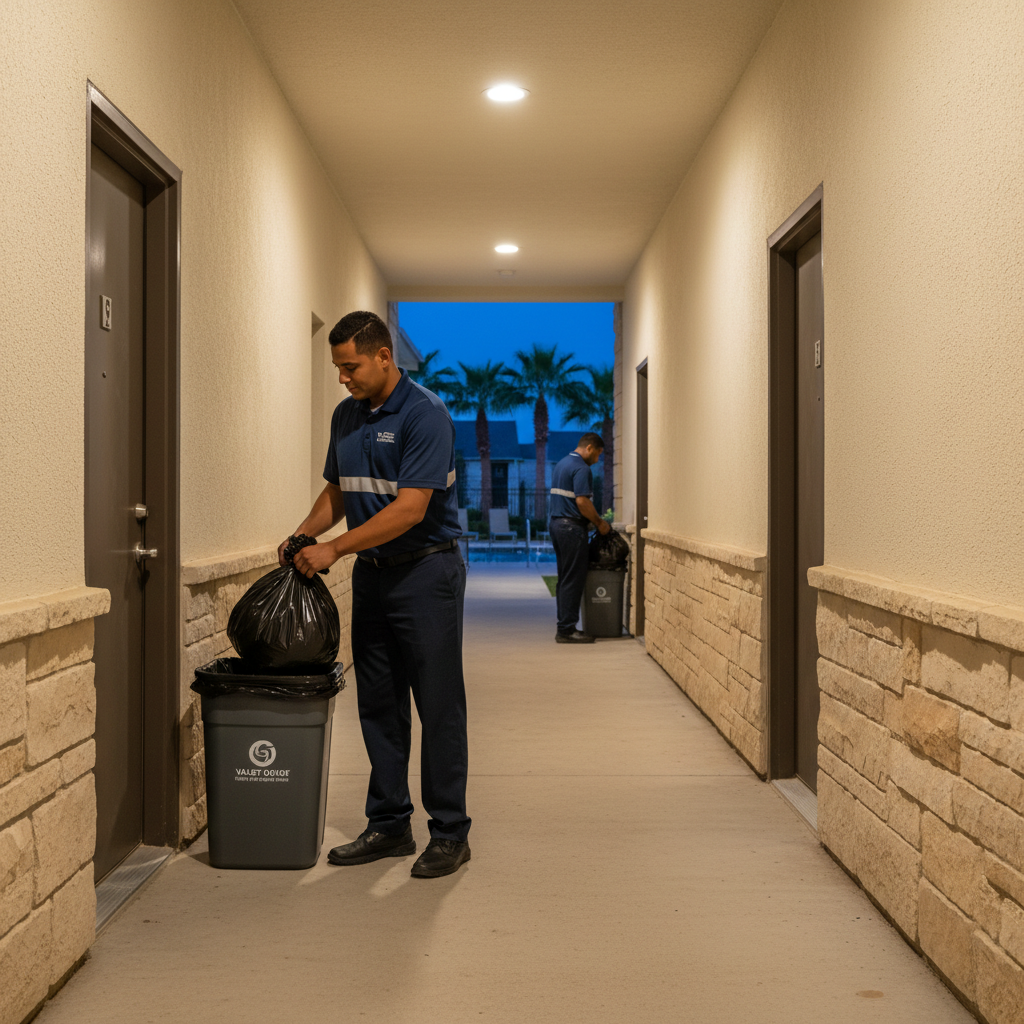
Best Valet Trash Companies in Texas: An Operator's Review
Finding the best valet trash companies in Texas requires looking past price to operational reliability, contract terms, and local market expertise. This guide breaks down the key performance indicators.
The best valet trash companies in Texas are those with a proven record of operational consistency, transparent pricing in the $8–$11 per door range, and deep knowledge of the Austin, Dallas, Houston, and San Antonio markets. Top-tier vendors differentiate themselves not on price alone, but on service execution and their direct impact on Net Operating Income (NOI).
TL;DR:
- Top Texas valet trash vendors are defined by operational reliability and local market density, not just the lowest per-door price.
- Key evaluation criteria include insurance coverage (specifically cyber and E&O), contract flexibility, and the quality of their service validation technology.
- The right partner functions as an extension of your site team, directly boosting ancillary revenue and resident retention with minimal oversight.
Defining "Best": A Framework for Texas Operators
To identify the best valet trash provider for your portfolio, you must evaluate them across three core operational pillars: Service Reliability, Risk Management, and Financial Impact. This framework moves beyond a simple cost-per-door comparison to a more robust assessment of a vendor's true value and potential liability.
Service Reliability & Consistency
Service reliability is the fundamental promise of valet trash: clean hallways and happy residents, every single service night. Inconsistent service directly translates to resident complaints, negative online reviews, and an increased burden on your site teams. A vendor's service framework is the most critical element to scrutinize.
Key indicators of reliability include:
- Labor Model: Do they use W-2 employees or 1099 contractors? W-2 employees generally offer greater control, training consistency, and lower turnover, which is crucial for stable service at a specific property. High turnover among 1099 contractors often leads to missed doors and inconsistent adherence to property rules.
- Service Validation: How do they prove service was completed correctly? The standard is GPS-tracked mobile apps where porters photograph each serviced door. Ask for a demo of their app. Can you, as the manager, access this data in real-time? Is it archived?
- Local Density: A provider with high density in a specific market (e.g., a strong presence in North Dallas or the Houston Energy Corridor) can better manage call-outs and labor shortages. They have backup porters nearby who can cover a shift, ensuring no service interruptions. A vendor spread thin across Texas lacks this operational agility.
Risk Management & Liability
Valet trash service introduces new personnel and processes to your property, creating potential liabilities. A premier vendor proactively manages this risk with robust insurance and contractual protections, safeguarding your asset. Inadequate insurance coverage is a non-negotiable dealbreaker.
- Insurance Stack: General Liability ($1M/$2M aggregate) is standard. The best operators also carry Workers' Comp, Commercial Auto, and, critically, Cyber Liability and Errors & Omissions (E&O) policies. Cyber insurance is vital if they use a resident-facing app, and E&O protects you from financial loss due to the vendor's failure to perform their professional duties.
- Contract Terms: Scrutinize the "Termination for Convenience" and "Cure Period" clauses. A 30-day termination for convenience clause is operator-friendly. Be wary of long cure periods (e.g., 90 days) that lock you into poor service. For a deeper dive on this, see our guide on Choosing a Valet Trash Vendor in Texas.
- Indemnification: The agreement should clearly state that the vendor indemnifies the property owner and management from any claims arising from the vendor's negligence or failure to perform.
Financial Impact & NOI Contribution
While vendor cost is a factor, the primary financial consideration is the service's impact on your NOI. The valet trash program is a profit center, not an expense line item. The right partner maximizes this potential.
This involves a simple but powerful calculation:
(Ancillary Fee Charged to Resident - Vendor Service Cost Per Door) x Occupied Units x 12 Months = Annual NOI Contribution
For example: ($25 Resident Fee - $9 Vendor Cost) x 300 Units x 12 = $57,600 in annual, high-margin revenue. This direct financial return is a key component of the valet trash benefits that boost multifamily NOI.
Comparing Valet Trash Companies in Major Texas Markets
The operational realities of valet trash vary significantly between Dallas-Fort Worth, Houston, Austin, and San Antonio. The best providers have distinct strategies for each market, accounting for traffic, property types, and local labor pools.
| Market | Key Challenge | What Top Vendors Do Differently | Red Flag |
|---|---|---|---|
| Dallas-Fort Worth | Geographic Sprawl & Traffic | Maintain high property density in sub-markets (e.g., Plano, Frisco, Arlington) to create efficient routes and ensure backup porter availability. | A vendor with properties scattered from Denton to Waxahachie with no central hub. |
| Houston | Humidity & Severe Weather | Implement strict, enforceable container rules (lids always on) and have a clear hurricane/flooding communication protocol for service suspensions and resumptions. | Vague or non-existent severe weather plans. |
| Austin | Competitive Labor Market & Hills | Offer higher-than-average pay to attract and retain W-2 porters. Routes are planned to account for the topographical challenges of hillside communities. | Reliance on 1099 contractors who may be less reliable in a tight labor market. |
| San Antonio | Mix of Garden & Mid-Rise | Provide hybrid service models and equipment (e.g., specialized carts for mid-rise corridors vs. traditional totes for garden-style breezeways). | A "one-size-fits-all" approach to service regardless of property layout. |
A top-tier Texas vendor demonstrates mastery of these local nuances. During a sales conversation, ask them directly how their operational plan for a property in Houston's Galleria differs from one in Austin's Domain.
The Service Level Agreement (SLA): Your Primary Tool
The Service Level Agreement (SLA) is the contractual document that defines a vendor's obligations. It is your primary tool for ensuring accountability. A weak SLA leaves you exposed to poor performance with no recourse. The best companies offer a clear, detailed SLA that is referenced directly in the main service agreement.
Your SLA should explicitly define:
- Service Hours: e.g., "Collection will occur between 8:00 PM and 10:00 PM, Sunday through Thursday."
- Violation Protocol: How are resident violations (e.g., trash out too early, unbagged waste) documented and reported to management? The process should be via app with photos.
- Missed Door Penalty: What is the financial credit or penalty for a confirmed missed pickup? This should be a per-door, per-incident credit back to the property.
- Compactor/Dumpster Area Cleanliness: The vendor's responsibility does not end at the resident's door. The SLA must require them to clean any mess left around the property's dumpsters or compactors resulting from their trash transport.
Before signing any contract, ensure these items are crystal clear. A vendor who is hesitant to commit to specific metrics in an SLA is not a top-tier operator. For more on structuring agreements, refer to our guide on how to find the best valet trash company for multifamily.
The ROI of Superior Service
Choosing a slightly cheaper vendor—for example, saving $0.50 per door per month—can seem fiscally prudent. However, this decision often results in a negative ROI when accounting for the hidden costs of poor service.
Consider this scenario for a 300-unit property:
- Vendor A (Cheap): $8.50/door. 5 missed doors per week. Assistant Manager spends 2 hours/week handling complaints.
- Vendor B (Operator-Grade): $9.50/door. <1 missed door per month. AM spends <15 mins/week on valet trash.
Let's quantify the "hidden costs" of Vendor A:
- Wasted Payroll: 2 hours/week x $25/hour (fully burdened AM rate) x 52 weeks = $2,600/year
- Lease Loss from Bad Reviews: One resident choosing not to renew due to service issues could represent a $20,000+ annual revenue loss.
- Reputation Damage: Negative reviews on Google and ApartmentRatings.com deter prospects, increasing marketing costs and vacancy loss.
The $1.00 per door price difference ($1.00 x 300 units x 12 months = $3,600/year) is dwarfed by the operational and reputational costs incurred by choosing the less reliable provider. The true ROI comes from seamless execution that protects your team's time and your property's reputation. For a full breakdown of this financial model, see our post on Calculating the ROI of Valet Trash for Apartments.
Choosing the best valet trash company in Texas is an exercise in operational due diligence. By moving beyond price and using a framework that prioritizes reliability, risk management, and true NOI impact, you can select a partner that enhances your asset and simplifies your operations.
Frequently Asked Questions
What is a reasonable price for valet trash service in Texas?
A reasonable vendor cost for reliable, insured valet trash service in major Texas markets like Austin, Dallas, Houston, and San Antonio typically falls between $8 and $11 per unit, per month. This price point allows the vendor to hire W-2 employees, maintain a robust insurance stack, and invest in service validation technology. Properties then typically charge residents a $20 to $30 monthly fee, creating a significant ancillary revenue stream.
How do I handle service issues or missed pickups?
The best valet trash companies provide a dedicated client portal or communications channel for reporting issues. The process should be simple: you report a missed door, they verify it against their service validation photo feed, and a pre-determined credit is applied to your next invoice per the SLA. Issues should be resolved within 24 hours.
Can valet trash service actually increase resident retention?
Yes. A high-quality, consistently delivered valet trash service is a premium amenity that residents value. It eliminates the need for them to carry trash across the property, often at night or in bad weather. This convenience contributes to overall resident satisfaction, which is a key driver of lease renewals and positive online reviews. It is one of the top benefits of valet trash for apartment managers.
What are the most important questions to ask a potential valet trash vendor?
Beyond price, you must ask: 1) Are your porters W-2 employees or 1099 contractors? 2) Can I see a demo of your service validation app? 3. Can you provide a certificate of insurance showing your General Liability, E&O, and Cyber coverage? 4) What is your standard contract term and termination clause? The answers will reveal their operational maturity.
How does valet trash impact my property's waste management costs?
A well-run valet trash service can actually help control and even reduce your overall waste management costs. By ensuring all resident trash is bagged and placed directly into dumpsters, it prevents the contamination of recycling streams, which can trigger fines from your hauling company. It also prevents illegal dumping of bulk items, as porters can report these issues directly to management.
What is the typical implementation timeline for starting service?
For a new valet trash service rollout, the typical timeline is 30 to 45 days. This allows for delivering resident containers, providing clear resident communication about the new service rules and start date, and finalizing route logistics for the vendor. A professional provider will supply all necessary resident communication materials. Learn more about the process in our guide to implementing valet trash.
Ready to upgrade your trash valet program?
Discuss your property-specific scope and quote with our team.
Related reading
How to Implement Valet Trash Service at Your Property
A step-by-step guide for Texas property managers on implementing valet trash service. Learn the 4-phase rollout, from vendor selection to resident onboarding and ROI tracking.
Valet Trash Service for Apartments Pricing: A TX Guide
Understand the real cost of valet trash service for apartments. Learn how the $8-$11/door vendor cost translates into a powerful ancillary revenue stream and boosts your Net Operating Income.
Valet Waste Service Operational Impact: A TX Operator's View
Valet waste service has a massive operational impact, cutting maintenance workload by 5-10 hours weekly and reducing waste-related costs by 15-20%. Learn how it impacts NOI.